
Introduction
Decentralized Autonomous Organisations (DAO) are today one of the main bottom-up and co-creative governance structures that allow for more digitalization. Historically seen, cooperatives and economic associations are nothing new but the DAO is a new way to organize, communicate, collaborate and make decisions as a network without the central authority and hierarchy that are typical for many organizations today. Because in a DAO, nobody has a status as a customer, employee or shareholder and/or manager or director.
In its basics, a DAO can be a business, social or another type of organization. A DAO can be an NGO, entrepreneurial network or food store. The structure of a DAO is that humans are not directly involved since operations between applications are taking place autonomously and decentralized while humans are cooperating indirectly regarding strategy, maintenance and administration. Decisions in DAOs are governed by proposals and voting to ensure everyone in the organization has a voice.
The way of the DAO
The DAO is also going to be more used within the SEEDS ecosystem as our community is growing. Thanks to that, all citizens and residents will be able to participate in the co-creation of a democracy where everyone decides on community governance and development. This is partly because the DAO is also about “collective wisdom” where people can collaborate and arrive at a consensus to solve problems and meet challenges. Within the DAO, a higher amount of information and knowledge can be gathered and used for operations and interactions.
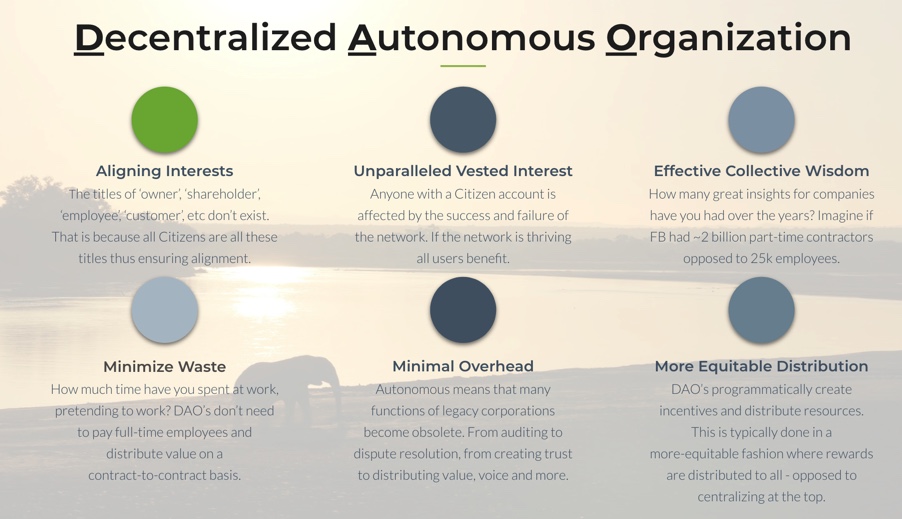
The DAO concept is also based on autonomy and decentralizes the process of programmatically create incentives and distributing resources. The idea for SEEDS is that this process can be done in a more equitable fashion where rewards are distributed to all as opposed to concentrating the decision-making with those at the “top” of a hierarchical system. The idea is that DAOs in SEEDS will contribute to overall community development regarding poverty reduction across the world and for a regenerative planet and human well-being.
The case for”Daomocracy”
When intellectuals imagined a better government over 200 years ago as in the USA, they didn’t have a concept of the internet nor the ability for instantaneous communication and value transfer via decentralized systems. Therefore, representative democracy via nation-states and parliaments was based on also promoting centralization. This is contrary to DAO’s ability to facilitate unparalleled information flows as well as the freedom to pursue passion and purpose in our societies, by providing more freedom to create with – whoever, whenever and however, communities and people desire.
SEEDS was also founded on views and ideas that current systems of governance as via representative democracy are already more or less outdated in comparison with different global problems and challenges of the 21st century, as when it comes to climate change. Also, thanks to the DAOs-concept SEEDS is a direct peer-to-peer governing framework with its own decentralized banking structure and organizations which are truly owned and directed by the people, for the people.
The current standard of the one-person-one-vote, direct-democratic systems has at least 3 notable and major flaws.
- It provides every person with an equal voice- where people may be unequally affected by an outcome.
- It is unable to capture degrees in which people are opposed to, or in favor of, an idea.
- Direct democracy has the potential to succumb to “mob rule”.
Therefore, one can say that the current binary and rigid direct- and representative- democracies don’t accurately represent the people that comprise them. For example, imagine a person whose livelihood is dependent on SEEDS has much more at stake than someone who simply uses the platform to make purchases occasionally. For such and other reasons, in SEEDS it is considered unreasonable to give every community member a 100% equal voice. Also, in a digital world, an equal voice as in pseudo-anonymous accounts opens up the possibility of proxy(fake/multiple) accounts for people to gain more political power.
Improving SEEDS democracy
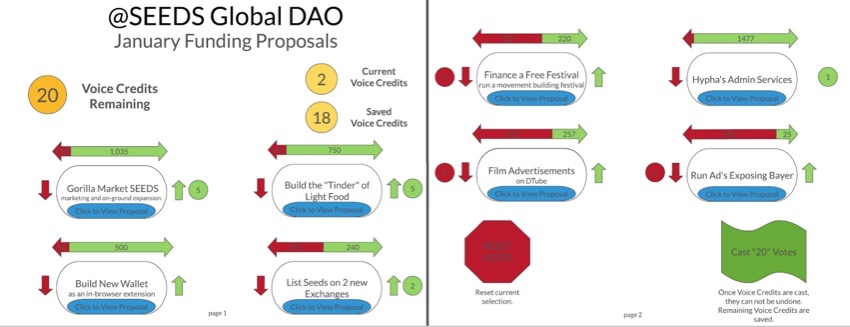
SEEDS is operating on behalf of ideas of liquid and tokenized democracy. This is also done by having Trust Credits as ‘tokenized votes’ that are distributed each voting month to all Citizens of SEEDS- relative to their previous month’s Harvests (contributions).
By doing so, the SEEDS model addresses many problems from voter-apathy, vote-wasting, majority ‘mob’ rule, binary choices, frivolous voting, etc. SEEDS voting protocols are established to facilitate better democratic governance, for example, where reputation is awarded to accounts that vote regularly. This distributes voice equal to an accounts Contribution Score where those who contribute more, have a greater voice.
An additional way to do it is for SEEDS and other communities to follow “The Way of the DAO” because it would lead to improving our decentralized communities and democratic systems when more people and applications can cooperate in co-creative and complex based processes instead of top-down and centralized models.