Introduction
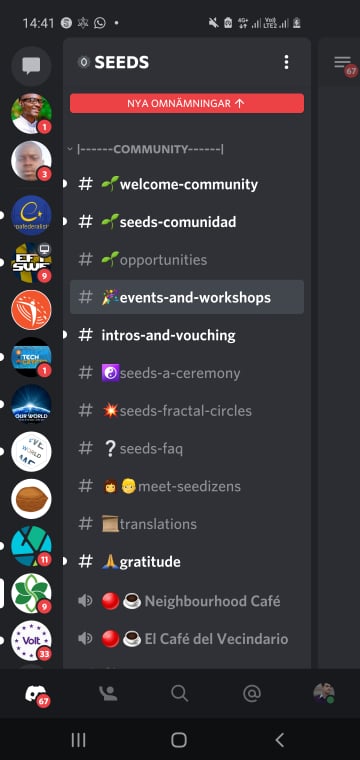
When I joined SEEDS in spring 2020, I also started using Discord for the first time. I was familiar with Discord before that and that it is a popular platform among gamers, hipsters, and younger individuals. Otherwise, among earlier plans for SEEDS was also to use platforms like Slack.
In general, today, it can be said that many SEEDS community members would agree that Discord is a useful tool for daily activities, conversations, and interactions. One can easily follow what is happening on the Hypha server and engage with each other. It is also an easy and user-friendly experience to write messages and has an overview of what is happening in different channels. Basically, Discord works well for SEEDS at the moment.
At the same time, it is important to have discussions and raise questions about how SEEDS will be organized in the future as things are developing forward and the community is growing. Discord is an efficient platform for organizing a community with 5000 members, but how to organize a community with 500 000 members?
Democracy software
Sooner or later as SEEDS is developing further, we who are visitors, residents, and citizens will need to move digitally to another platform. SEEDS on Discord will become an important part of SEEDS history and foundational legacy that future generations of SEEDS members will read about. Instead of Discord, our community will have to choose another platform, software, and digital tool where our interactions will take place.
Decentralization is a process of making it easier for humans to do things together without “middle-men” as banks also offer a big potential for the future of democracy. Thereby, decentralization via SEEDS enables individuals to cooperate, co-create and construct solutions and projects via democratic conversations where more knowledge and humans can be involved. From a historical point of view, just as the citizens of Athens were able to meet at the Agora square to discuss politics and problems, modern citizens as can meet in digital communities and platforms to do the similar. However, the question is which “Digital Agora” would be the best choice?
For a start, it is important to keep in mind that there are several so-called “democracy software” programs, places, and platforms existing since the 1990s. These are, for example, Direct Democracy Database, CHVote, and D-CENT. However, none of these platforms has been able to become “mainstream” in the sense of the number of users and overall impact. One challenge for more or less all such platforms and programs is that they end up being very limited to certain individuals and communities, even to certain countries and cities, instead of being global or even better “glocal” as being optimal for local and global processes at the same time.
Time for a new platform
Since it will be a matter of time until our community needs to find a new digital home, it is important to consider the following aspects and criteria when it comes to choosing the future platform.
- Glocal – The platform should not be limited or specialized geographically, such as focusing on the local or global levels of democracy and governance. Instead, the platform has to be glocal so that SEEDS members can engage in processes and developments at different levels of governance. After all, solving climate change and crisis problems is about “think globally, act locally” behaviors and actions.
- Crypto-friendly – The platform should operate by the inclusion of cryptocurrencies in its everyday operations. This means that SEEDS members and others should be able to use cryptocurrencies to reward individuals and fund projects that are seen as important for climate transformation and social well-being. Hopefully, Seeds could also be one of the most used currencies on such a platform.
- Constitutional and transparent – The platform should have its own constitutional arrangement regarding human rights, personal integrity, and a rule-of-law mechanism for solving problems and disputes between community members. Basically, the platform should have a similar structure, values, and categories as SEEDS constitutional set-up. Blockchain will be a vital part of such a platform in order to ensure openness, transparency, and safety for all humans.
- Interconnected and interoperable – Last but not least, the platform should be very interconnected in the sense of including different individual, community-driven, private and public institutions that are able to cooperate and interact in solving different problems and challenges. This means that SEEDS will have its own governance and community life on the platform while at the same time being able to interact with others as with different communities and public institutions as the UN.
The importance of AI
As you read this article, there is a competition between digital democracy and digital dictatorship taking place. SEEDS is, of course, an example of the promotion of digital and decentralized democracy being developed. While for example, China as a government and state is an example of the promotion of digital dictatorship. The difference being one has people telling the tech what to do, while the other has the tech telling the people what to do.
Democracy is not a zero-sum game since more people can be involved and co-create solutions. Still, there is a zero-sum game between democracy and dictatorship regarding which model of governance and decision-making will dominate globally. This development also raises questions about how AI and machine-learning technology should be used?
While China is an example of aspirations to us the AI for empowering and strengthening central power and control, there are, of course, ideas on how AI should be used to empower and strengthen democracy. The AI could be used to categorize, analyze, and process large amounts of information. This is important in order to make it easier for a large number of humans, for example, 10 million people, to really be able to participate in democratic conversations and procedures.
Let us, for example, say that 200 million people are commenting, debating, and voting on a topic regarding energy policy in a certain nation. Millions of opinions, comments, and emotions are being presented and written on the social platform citizens are using. It would be impossible for an individual citizen to read all the comments being made during the debate. The AI could make it easier for us to understand different arguments, views, and opinions being expressed by processing information and making different categories, such as describing arguments in favor and against the given proposal.
Also, AI would be used for gathering knowledge because involvement in liquid and decentralized democratic procedures means that more knowledge and expertise can be gathered. Thanks to digital tools, citizens can contact other individuals and communities such as experts and academics to receive facts and insights about different topics such as climate, welfare and transportation. With the usage of AI, it will become easier for a larger number of humans and amounts of knowledge to be involved in decision-making processes and governance at local and global levels.
SEEDS in 2030?
It is only a matter of time until SEEDS will have to migrate to a more optimal and complex platform when it comes to governance and democratic procedures. This is partly to make it easier for a much larger SEEDS community to operate and partly to integrate the SEEDS community into a global democratic sphere that is going to develop during the 21st century. Therefore, one of the main questions is which platform is going to be used by SEEDS and how citizens will decide towards the 2030s, and SEEDS’ first decade.
Hopefully, the “Post Discord” phase will lead to SEEDS regenerating itself into a more complex and much larger community with millions of visitors, residents, and citizens that are able to cooperate and improve our planet in harmony, wisdom, and creativity.